
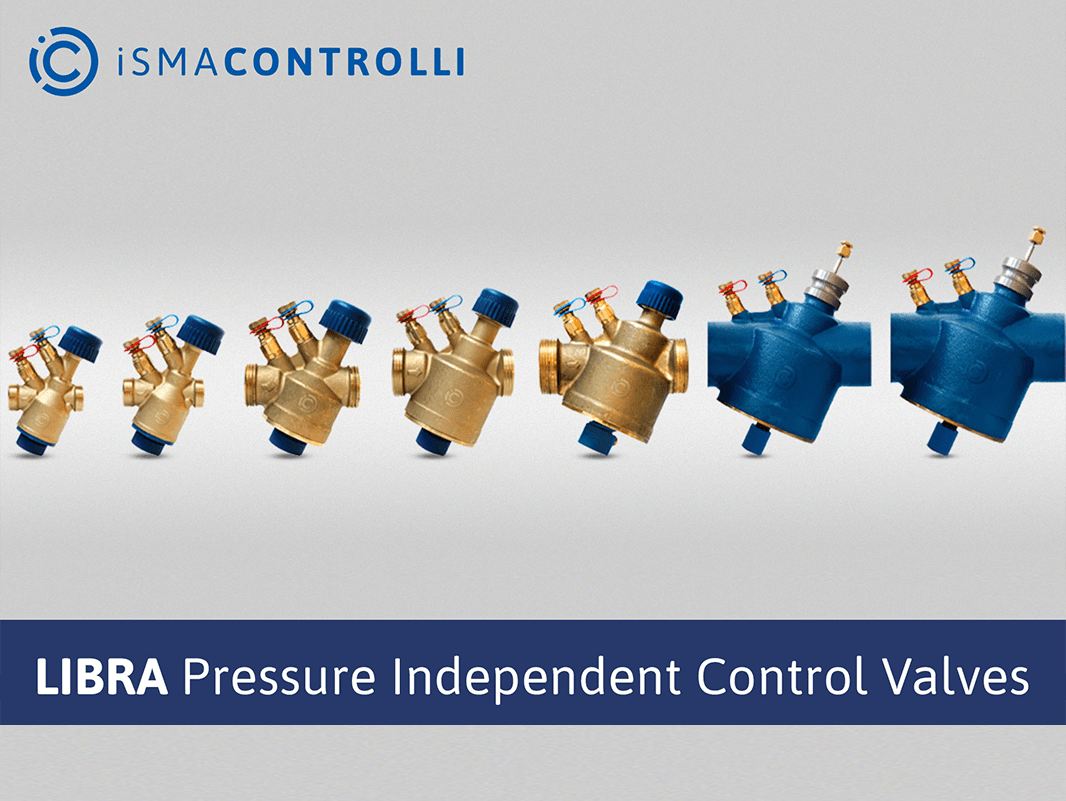
Energy saving is one of the important factors while designing a modern HVAC system.The automation system alone is not enough to build an energy-efficient system, field devices such as sensors, valves and actuators are no less important.
What is needed to build a sustainable system in a building?
The BMS must properly control the heating/cooling power delivered to the building by controlling the water flow to the coils. One of the energy-saving factors is to avoid overflow conditions which are responsible for high electrical power consumption by the circulating pumps, as well as efficiency loss of the heating/cooling generators. In this perspective, control valves need to modulate the flow according to the PID temperature loop, regardless of the unavoidable system pressure fluctuations. PICVs are the ideal for refrigeration, heating, or air conditioning systems.
Pressure Independent Control Valves popularly known as PICVs are control valves able to maintain a constant flow rate within a given range of differential pressure drops.
PICV is three-in-one compact valve body
- Control Valve
- Differential pressure controller
- Static flow limiting valve
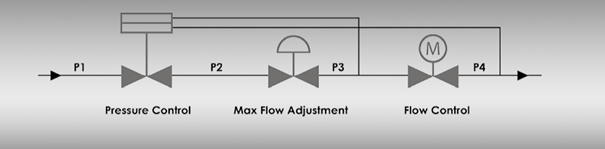
A differential pressure controller in the valve body provides proportional control of the differential pressure across the control valve plug (P3-P4) and the resulting flow will depend only on the position of the flow control plug that is driven by the BMS. The BMS is therefore controlling the flow supplied to the coil and not simply the position of the valve.
PICVs eliminate overflows regardless of fluctuating system pressure thus reducing the pumps energy consumption as well as avoiding ∆T degradation and the following loss of efficiency of boiler/chillers.
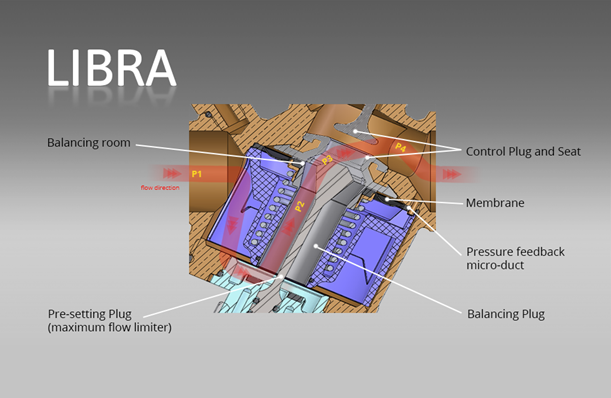
PICV valve main parts, and the principle of operation
Q=Kv*√∆P
Q – flow rate [l/h]
Kv – valve opening
∆P – differential pressure [bar];
∆P = P2 – P3, where P1 = inlet pressure; P2 = intermediate pressure; P3 = outlet pressure
We need to keep ∆P constant across the control valve plug
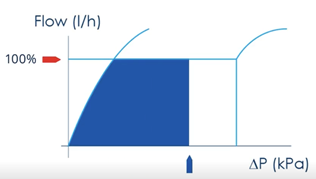
In order for the valve to maintain a constant flow regardless of pressure changes, the differential ∆P for P1-P4 must be in a range between Pmin and Pmax which is a specific technical characteristic of the valve. As long as the valve’s differential pressure is in the Pmin-Pmax range, the flow will be constant.
LIBRA valve main components
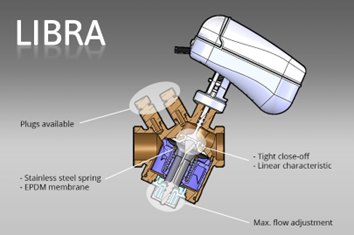
LIBRA – Main advantages of using PICVs
- One PICV replaces up to three separate valves (a 2-way control valve, a flow limiting valve, a differential pressure control valve)
- Optimum control in heating and cooling circuits with variable flow systems
- Flow rate can be precisely set at its specified design value
- Constant flow across the control valve regardless of changes in pump speed or valves closure elsewhere in the system
- Authority close to 100%
- Linear valve characteristics regardless of the preset value
- 100% stroke always available regardless of the preset value
- No cartridge design
- Very low hysteresis
iSMA CONTROLLI LIBRA – Wide range of Pressure Independent Control Valves
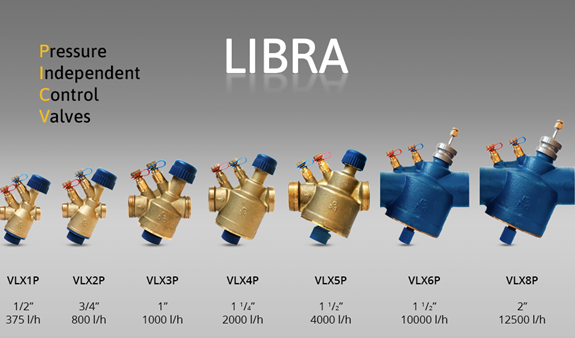
The importance of Energy Valves
Heat exchange depends on the flow rate and ∆T achieved on the heat exchanger. With the use of PICVs, we keep the flow independent from ∆P but do not control ∆T.
In that case, your application needs the use of energy valves that control both ∆T and keep the flow independent from the pressure. Our EBV Energy Valves will be described in the coming soon article.
Author: