

What do you think when you hear the ‘building’ word?
Do you think home? Do you think the place where you spend time with your friends, with your co-workers, with your family? Do you think about a place where you feel safe? How would you describe that building? Is it a 99-floor skyscraper, 2.000 square meters warehouse, a two-story house?
The definition for each of us is different, but still, there is much in common in each of them. All of them have doors, windows, rooms, need ventilation systems. The building needs energy! Depending on the living area, each of the buildings needs a heating system when it’s cold or a cooling system when it gets too hot. The building, like a living organism, needs water to perform the basic functions for which it was designed. It needs lighting! To provide a sense of security we quip the building with alarm systems and intrusion detection, security cameras, and access control.
What requires monitoring in the building?
It seems like a lot of different areas in the building need to be monitored and then controlled. To enable the building to perform, we need to think about the things that need monitoring. Temperature sensors, humidity sensors, presence sensors, motion sensors, contact sensors, Water flow meters, energy meters, smoke detectors, wind speed sensors, sun sensors… we can count for hours the things that may be monitored in the building!

Alright, we have all the sensors installed in the building. Now let’s recognize what type of signals do we get from each sensor. Let’s say we installed an NTC 10K temperature sensors, how do we get that data out of them? Same thing with the presence, motion, wind speed sensors, and other types of sensors. To ensure many years of trouble-free operation most of the sensors that are used in the commercial buildings are based on analog signals. A huge part of the data that is being monitored is based on the 5 main input types -> Temperature, Resistance, Voltage, Current and Binary Signals.
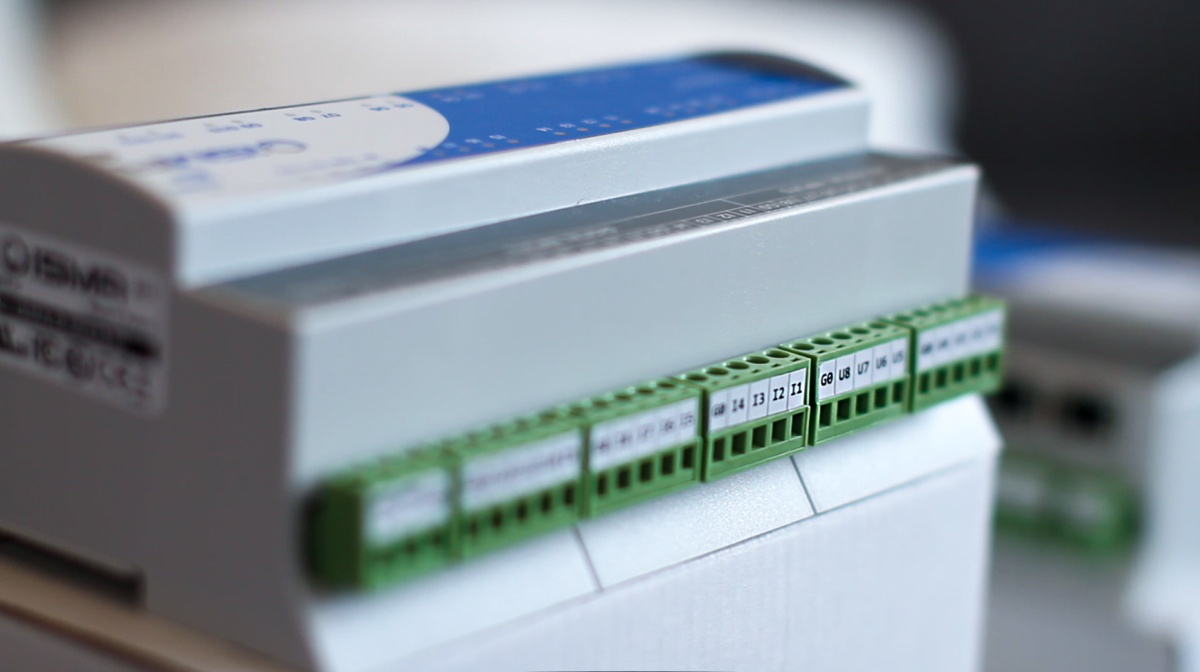
To ensure the possibility of monitoring the data and to be able to control the building we need to enable the conversion of analog values into the digital world. Ideally, we would need one device or a group of devices that can gather all the data from the building and convert it to a digital form that can be processed later!
Cost-effective solution for maintaining perfect building conditions
With all the monitored data we can see and understand how the building lives! That powerful knowledge can lead to, among others, the creation of ideal temperature and humidity conditions inside the building as well as in every room. Such a solution allows not only to maintain perfect working and living conditions but also to ensure that it will be a cost-effective solution in the long term.
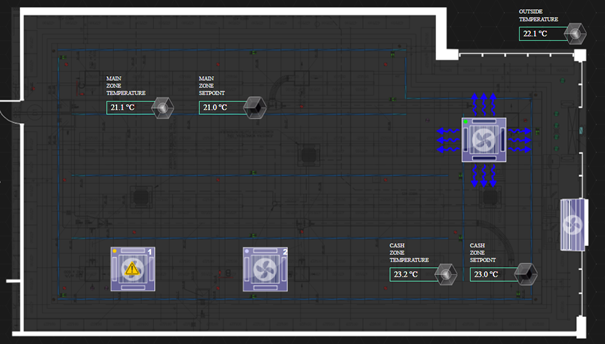
Now, while we have all the data monitored and we know what would be controlled we need equipment that physically enables control of the fans, heaters, coolers, dumpers, inverters, actuators valves, and dozens of devices used in the building.
At that point, we recognize Analog and Digital Signals. The vast majority of devices can be controlled with a 0-10 V signal that enables the device to work in the range of 0-100%. In the inverter, the signal is responsible for 0-100% of the motor speed. In the case of a three-way valve for mixing hot and cold water. Digital signals are simple two states ON/OFF, TRUE/FALSE, 1/0 signals. With digital signals, a light can be turned on, a fan speed can be controlled, cooler or heater can be enabled and disabled.
Building automation systems for communication and scalability
Depending on the scale and the size of the building all devices might be controlled from one place – a control panel or might be distributed all over the building. From the rooftop where an Air Handling Unit (AHU) may be placed to the basement with the heating substation. To enable various devices in the building to share information they need to speak the same language. In the Building Automation Systems (BAS) a standard for open communication are:
- Modbus – open communication protocol created in 1979 by Modicon, used widely as a standard protocol in automation
- BACnet – open communication protocol created especially for Building Automation and Control (BAC) networks
To enable communication between devices, two types of physical connections are being used – RS485 and Ethernet.
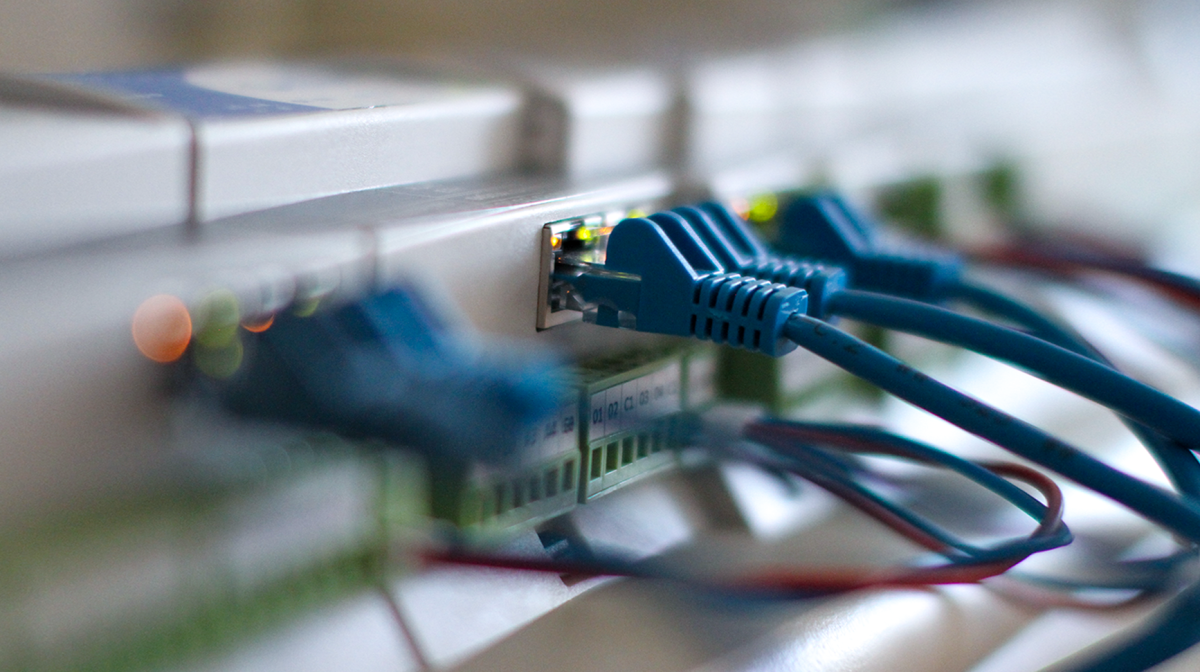
Both BACnet (MS/TP and IP) and Modbus (RTU/ASCII or TCP/IP) are fully operative and can share information between devices enabling monitoring and control.
Input and Output used in the building
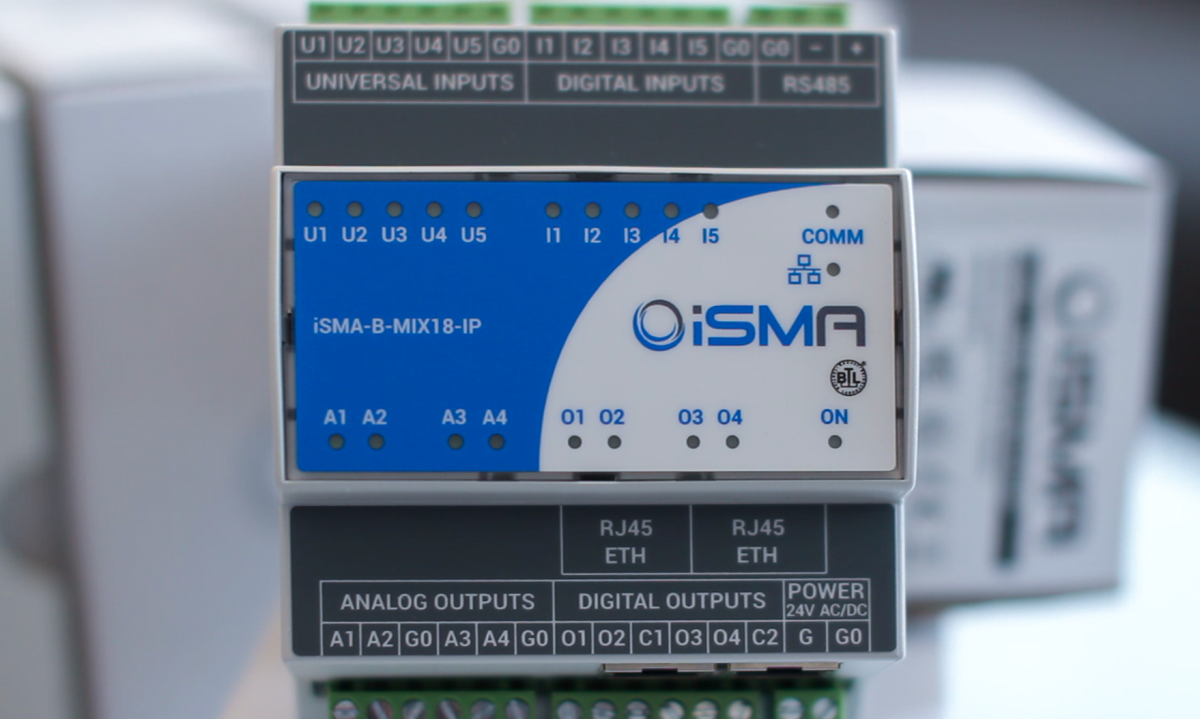
BAS needs to be flexible in terms of scalability and the possibility of implementing changes. That means open protocols, a full range of input and outputs, and various communication methods. That is why 18 types of iSMA I/O Modules can be found in iSMA portfolio, with support for all of the types of Input and Output used in the building:
- Universal Inputs
- Digital Inputs
- Analog Outputs
- Digital Outputs
- Triac Outputs
Each type of iSMA I/O Module can be found in -IP version with Ethernet onboard or RS485 port only version. IP based iSMA I/O Modules are equipped with BACnet IP, Modbus TCP/IP, and Modbus Gateway while serial bus iSMA I/O Module with BACnet MS/TP and Modbus RTU/ASCII. Protocols can be configured in seconds, without even connecting to the module thanks to the DIP Switches located under the top cover.
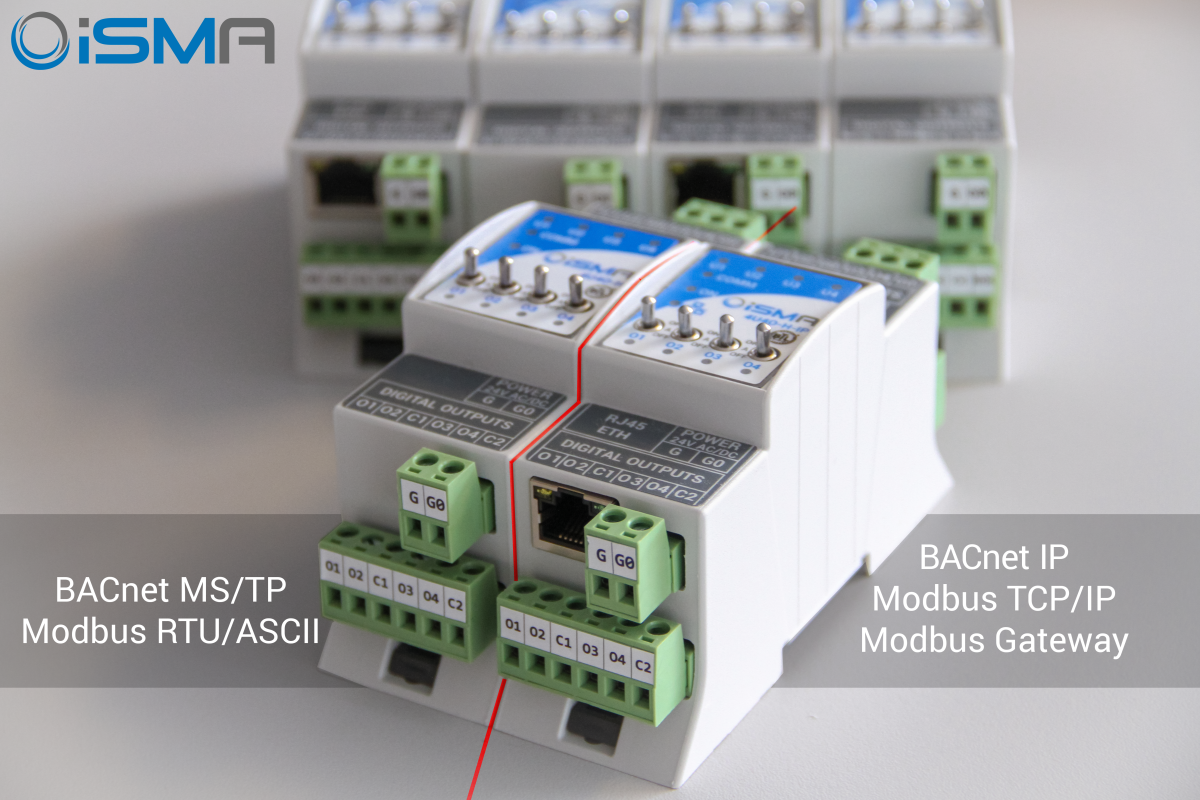
iSMA I/O Modules: iSMA-B-MIX Series and iSMA-B-MINI Series
iSMA I/O Modules are categorized into two main groups: MIX Series and MINI Series.
iSMA-B-MIX Series is equipped with a MIX of all types of I/O in one unit. I/O Modules in that group:
- iSMA-B-MIX38 with 38 I/O’s
- iSMA-B-MIX38-IP with 38 I/O’s and two ethernet ports
- iSMA-B-MIX18 with 18 I/O’s
- iSMA-B-MIX18-IP with 18 I/O’s and two ethernet ports
iSMA-B-MINI Series has been designed to complement the I/O modules of the MIX series. Unlike the MIX series, the MINI line is dedicated to all applications, where hand operating switches are required. The built-in light, cooling, and heating algorithms make them applicable as standalone controllers. Additionally, the modules support time relay modes dedicated to present detectors.
I/O Modules in that group:
- iSMA-B-4I4O-H with 4 Digital Inputs and 4 Digital Outputs with hand control
- iSMA-B-4I4O-H-IP with 4 Digital Inputs and 4 Digital Outputs with hand control and ethernet port
- iSMA-B-4O-H with 4 Digital Outputs (8A) with hand control
- iSMA-B-4O-H-IP with 4 Digital Outputs (8A) with hand control and ethernet port
- iSMA-B-4TO-H with 4 Triac Outputs with hand control
- iSMA-B-4TO-H-IP with 4 Triac Outputs with hand control and ethernet port
- iSMA-B-4U4A-H with 4 Universal Inputs and 4 Analog Outputs with hand control
- iSMA-B-4U4A-H-IP with 4 Universal Inputs and 4 Analog Outputs with hand control and ethernet port
- iSMA-B-4U4O-H with 4 Universal Inputs and 4 Digital Outputs with hand control
- iSMA-B-4U4O-H-IP with 4 Universal Inputs and 4 Digital Outputs with hand control and ethernet port
- iSMA-B-8I with 8 Digital Inputs
- iSMA-B-8I-IP with 8 Digital Inputs and ethernet port
- iSMA-B-8U with 8 Universal Inputs
- iSMA-B-8U-IP with 8 Universal Inputs and ethernet port
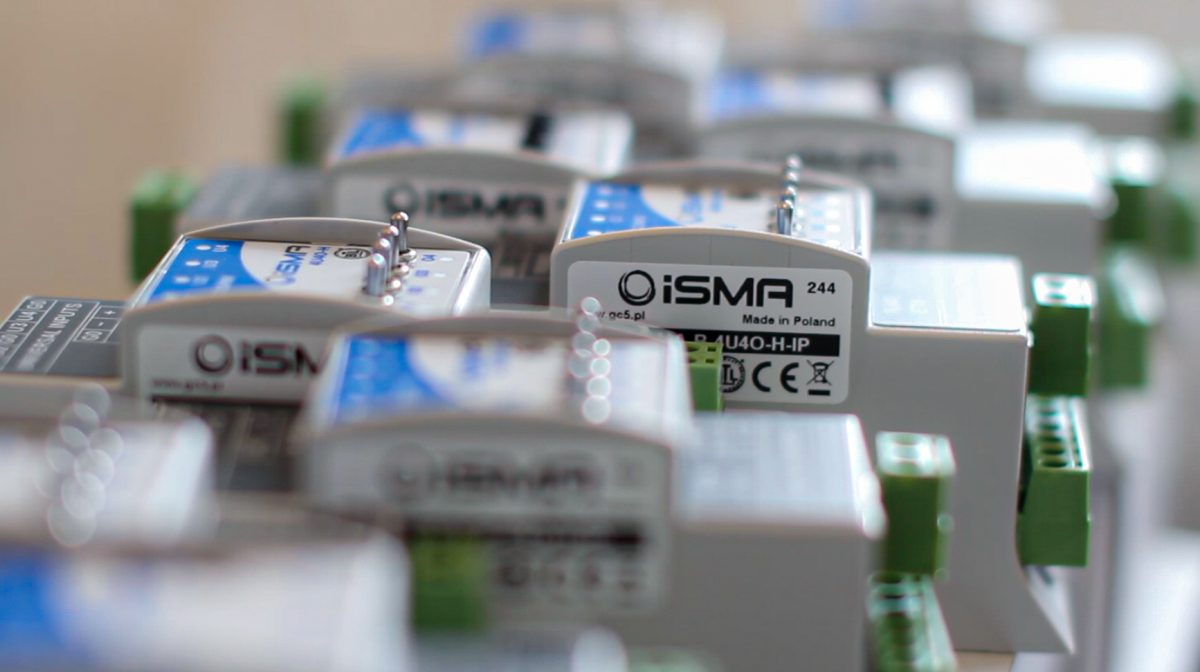
Standalone applications built-in iSMA I/O MINI Series like iSMA-B-4U4O can help to create a distributed control system in the building. An I/O Module can work locally as a standalone controller. The module alone can provide heating and cooling control based on the temperature measurement, setpoint, and differential value settings. It can be also used for light control or a time relay, so the light can be switched off after a pre-configured time. Based on the input iSMA I/O MINI Series can control the output as:
- Monostable Relay,
- Bistable Relay,
- Time Relay NO and NC,
- Input Forwarding,
- Heating,
- Cooling.
iSMA I/O Modules together with iSMA Controllers can be your All-In-One solution for building digitalization. Whether it is a newly built facility or the existing building, iSMA Products will allow for its digitalization, which will enable better energy management, lowering the cost of maintaining the building and ensuring greater safety and comfort of its users.
Author:
Paweł Szarmański