
Cutting Costs for Small and Medium Businesses with BMS
In an era of rapid environmental changes and rising operating costs, many small and medium-sized businesses (SMBs) are facing new challenges in managing energy consumption and building operations. While building management systems (BMS) have been a mainstay in large commercial buildings for years, their adoption rate in smaller buildings remains surprisingly low. This gap often comes from the perception that BMS solutions are complex, costly or not properly scaled for smaller facilities. However, modern advances in BMS technology are changing this paradigm, making energy and comfort management accessible, scalable and critical for small and medium-sized buildings.
Why Do So Many Small Sites Lack a BMS?
Despite the fact that the Small and medium-sized buildings consume 44% of the total commercial buildings’ Energy consumption, the fact is, only 13% of these buildings have a Building Automation System that would control HVAC, and other parts of the building. Overall almost 90% of small and medium sites today do not have a BMS, and the reasons for this are numerous. The primary factor is cost—traditional BMS solutions are often designed for large-scale operations, requiring significant upfront investments.
Many building operators, especially in smaller facilities, tend to view these systems as more of a luxury than a necessity. Often, there’s an underestimation of the potential energy savings and operational improvements that could be achieved with a BMS. Some SMB owners or facility managers may believe their current energy consumption is as efficient as it can be, when in fact, there are significant savings to be unlocked through the automation and optimization of HVAC, lighting, and other building systems.
Additionally, smaller sites often operate on tight margins, meaning that any investment must demonstrate a clear return on investment (ROI). The perception that BMS solutions are too costly or complex, along with limited awareness of more accessible options tailored for smaller buildings, leads many facilities to continue operating without the benefits of energy optimization and efficiency.
Energy Savings Opportunities
For small and medium-sized businesses, energy costs represent a significant portion of operational expenses. However, energy consumption in these buildings is often unmanaged or inefficient, with systems running around the clock, even when buildings are unoccupied. This leads to wasted energy and inflated utility bills.

Even the basic control over heating ventilating and air conditioning systems (HVAC) and lightning can dramatically reduce costs. A well-designed BMS, handling HVAC together with lighting and room/zone temperature levels based on occupancy or smart scheduling can offer SMBs energy savings of up to 30% by optimizing building systems to operate only when needed and at the most efficient levels.
Furthermore, modern BMS platforms can provide actionable insights. This means that facility managers can track their energy usage in real-time, identify inefficiencies, and make data-driven decisions to optimize their systems. This not only drives down costs but also contributes to a building’s overall sustainability.
Post-pandemic landscape of building occupation
As businesses adapt to the post-pandemic landscape, BMS technology is becoming even more critical. With hybrid work models and fluctuating occupancy levels, the need for flexible, scalable building management is higher than ever. A BMS allows SMBs to adapt to these changes in real-time, ensuring that their buildings are as efficient and comfortable as possible, no matter how many people are in the office.
For example, during periods of no/low occupancy, a BMS can automatically reduce heating or cooling loads, dim or switch of the lights, cutting down on energy usage. Additionally, the ability to remotely monitor and control building systems thanks to cloud integration possibilities of modern systems means that facility managers can ensure that everything is running smoothly, even when they’re off-site.
Market shifts towards small and medium-sized buildings
The good news is that BMS technology is rapidly becoming more accessible for smaller buildings. Historically, BMS solutions were primarily targeted at large commercial properties, but this is changing. The market is now seeing the development of solutions specifically tailored for smaller buildings, with a focus on affordability, scalability, and ease of installation.
Modern BMS solutions for small and medium-sized buildings make it possible to control a small building, such as an office, a store, or a gas station with a use of one but powerful controller. These products are designed to integrate with existing infrastructure, reducing the need for costly retrofits. The result is a solution that offers immediate savings and operational improvements, without the traditional barriers of cost and complexity.
iSMA CONTROLLI at the forefront to provide scalable solutions for small and medium-sized buildings
When considering the best BMS options for small and medium-sized buildings, the MAC36NL and MAC36PRO controllers stand out as the most versatile, all-in-one solutions. Both controllers offer a powerful yet affordable platform for integrating and managing building systems efficiently. Controllers are powered by Niagara Framework and offering unlimited integration possibilities with existing systems in the building, which is very important for retrofit applications. 36 on-board I/O offers control of the HVAC system and real-time programming capabilities with support for alarming, scheduling, trends, emails and much more allows for creation of a efficient building management system. MAC36 controllers are expandable with a wide range of I/O modules from the iSMA CONTROLLI range, VAV controllers, FCUs enabling the creation of a complete BMS solution.
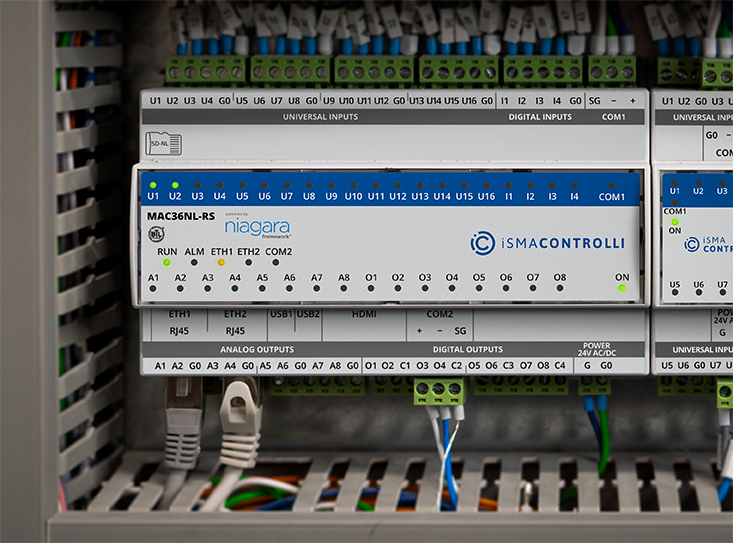
The MAC36NL is a compact yet robust solution that provides small sites with comprehensive control over their HVAC, lighting, and energy systems. With support for both Ethernet and RS485 integration, it offers flexibility in installation and scalability for future needs. The controller also integrates seamlessly with existing systems, allowing SMBs to optimize energy usage without overhauling their infrastructure.
Meanwhile, the MAC36PRO steps up for slightly larger sites or those with more complex needs. It offers all the features of the MAC36NL but with enhanced processing power, making it perfect for medium-sized buildings with multiple systems to manage.
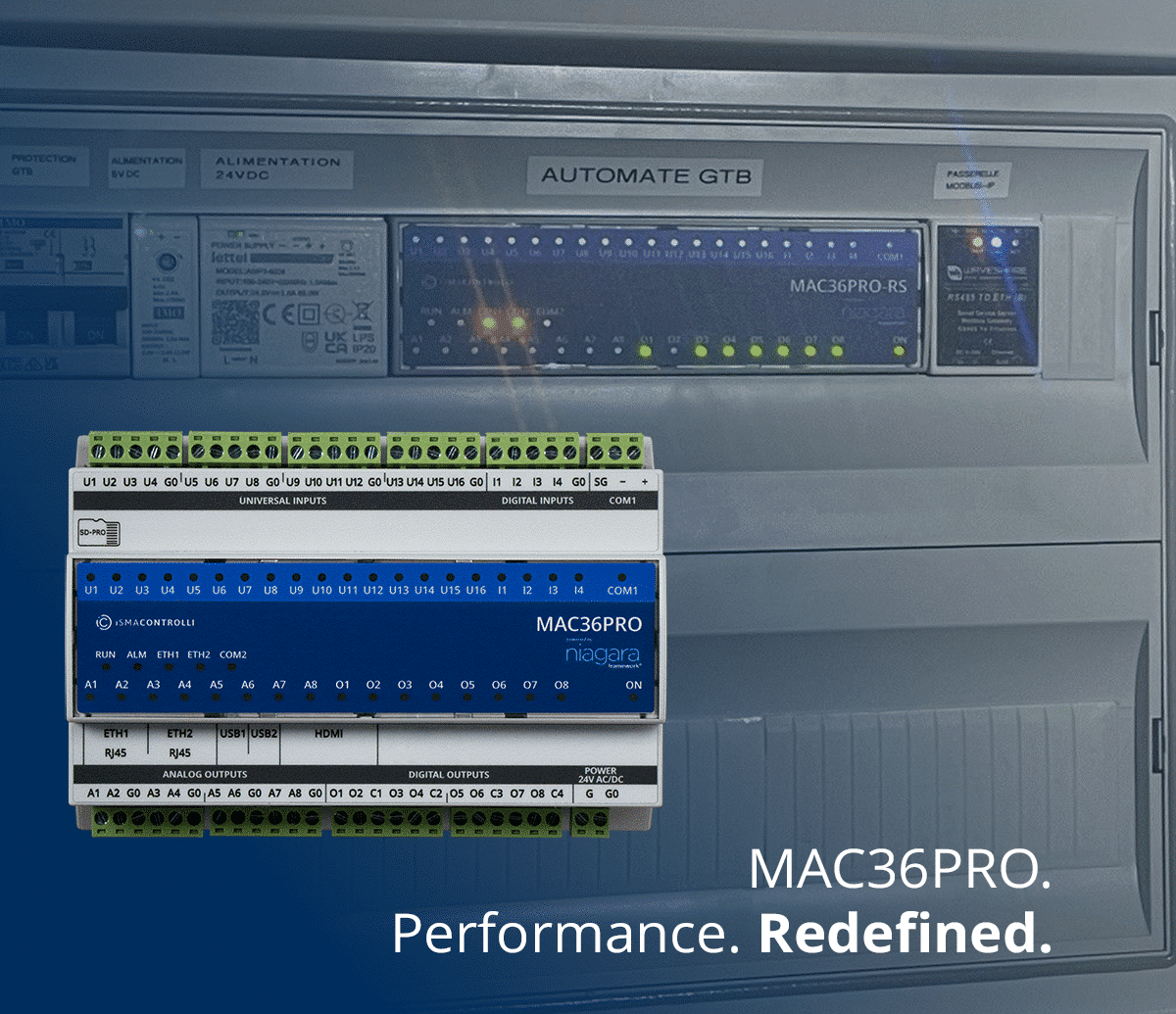
Both controllers offer secure integration with cloud-based platforms, giving facility managers the flexibility to oversee operations remotely, a feature particularly valuable in today’s increasingly hybrid work environments.
Author:
Pawel Szarmanski
Solution Product Manager