

One of the major civilization problems is fighting against growing air pollution. The basic equipment used for gathering air samples for analysis is an aspirator. We have developed a prototype of a wireless, portable aspirator for taking air samples. The device can be placed in a facility that generates pollution (e.g., a chimney), and the process of gathering an air sample can be controlled and monitored directly from a PC.
Constructing a Wireless Aspirator Prototype
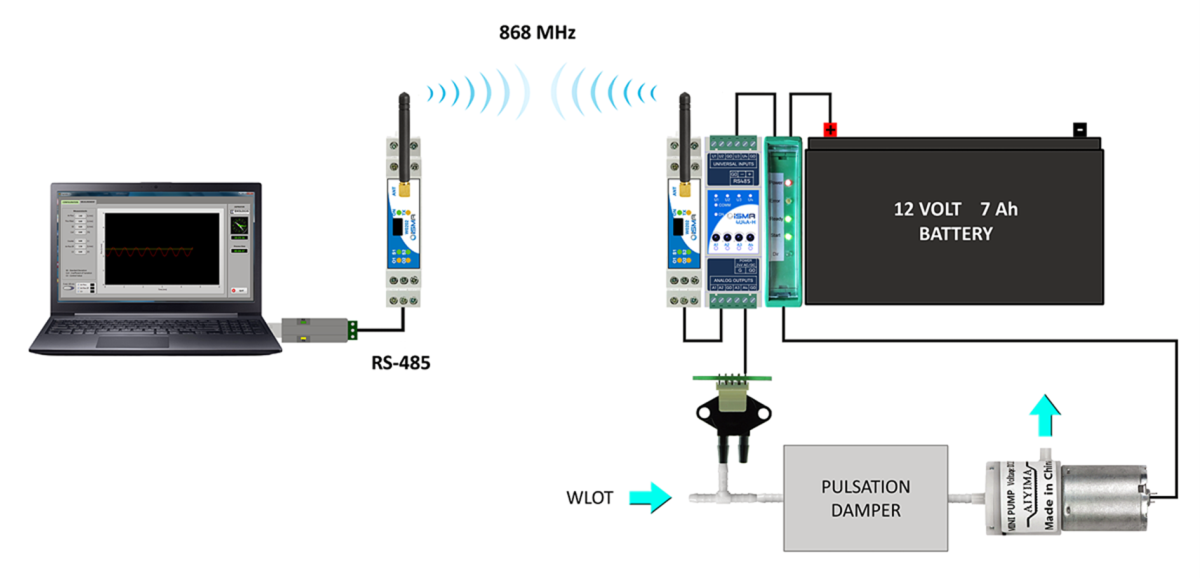
The prototype of a wireless aspirator for gathering air samples was developed based on a 12 V DC air pump and differential pressure sensor, DRMOD-I2C-PD0B1 0-10 kPa. The devices were coupled with a specially designed airflow pulsation damper. These elements established a foundation for an air flow regulation system with a PID algorithm. For differential pressure measurements, we used an I/O module of 4 universal inputs and 4 analog outputs,
the iSMA-B-4U4A-H Multiprotocol I/O Module from iSMA CONTROLLI. Analog inputs of the module allow measuring a voltage signal from the pressure sensor with 16-bit resolution. The module is also equipped with four 0-10 V DC analog outputs, allowing to set the output voltage with a 10 mV accuracy. The voltage signal was connected to a DC motor controller, SDC 106 from WObit, which proportionally controls a speed of an air pump engine. The I/O module was connected with an RS485 interface with a wireless Modbus RTU gateway, the iSMA-B-W0202.
A second identical iSMA-B-W0202 wireless gateway was connected to a portable controlling PC with a USB to RS485 converter.
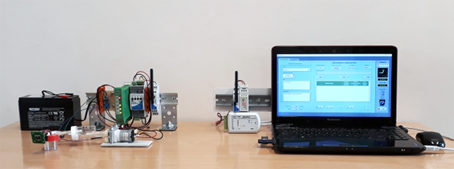
A 12 V DC 7 Ah gel battery was used to power up the prototype with two DC/DC voltage converters with outputs of 5 V DC (powering the DC motor controller and differential pressure sensor) and 24 V DC (powering of analog I/O module and communication module).
The aspirator with the battery power supply worked for 8 hours continuously, 100 meters from the controlling PC.
Software Controlling the Work of the Aspirator
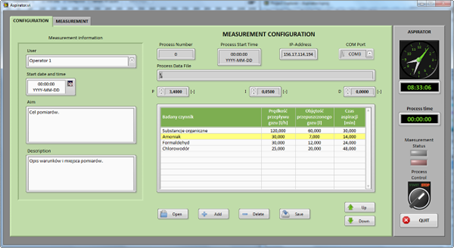
Dedicated software was designed in a graphical programming environment, LabVIEW.
The application included a formula editor, which allowed for adding a new formula of a collected air sample, editing it, removing it, and saving it to a file. The program automatically selected aspirator settings, allowed for observing the process of collecting a sample on a chart, and realized the PID regulating algorithm for the speed of the DC motor for an air pump.
Tests of the Wireless Aspirator Prototype Operation
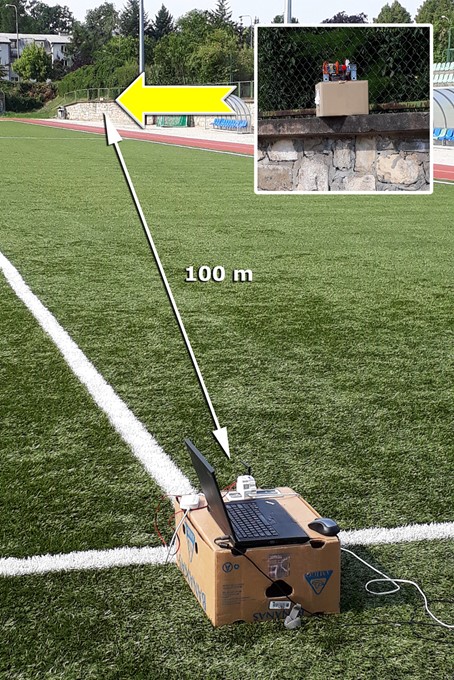
The tests were carried out in an open space, placing the aspirator at different distances and heights from the controlling PC. All results obtained during the tests came within the range of the Polish Standard PN-EN ISO 13137:2014-02 as of 18 February 2014, which says the maximum value of an air flow oscillation for aspirators is ±5%.
Autore:
Egzo Soft, Daniel Borowiak